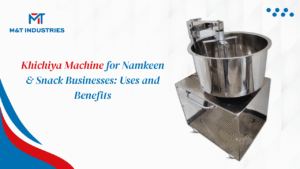

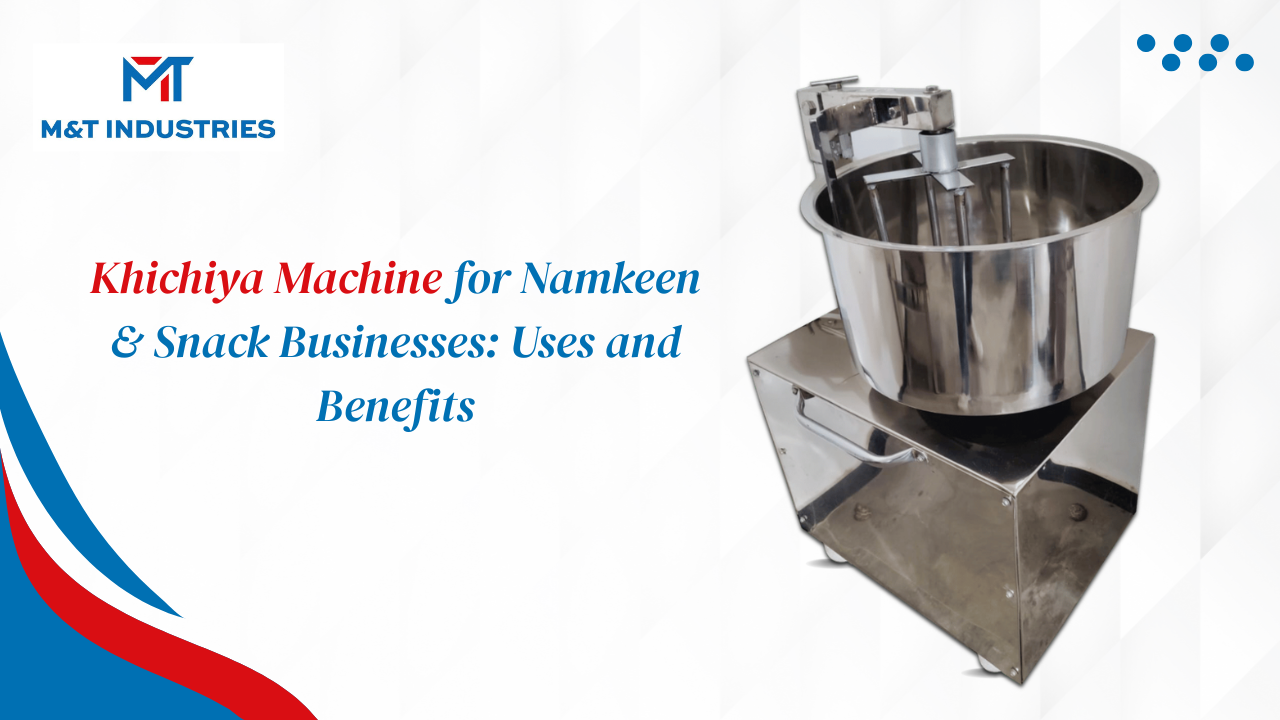
Want to grow your snack output without losing that authentic taste? Tired of high labor costs and dough that never comes out the same twice? A commercial Khichiya Machine can fix both problems. It cooks, kneads, presses, and rolls dough in one smooth setup. You get higher output, need fewer workers, and enjoy better margins. This guide explains how the machine works, what specs to check, which snacks you can make, and how it helps small businesses grow. Read on and decide if it fits your unit.
A namkeen unit needs steady taste, even thickness, and clean handling. Hand-made dough rarely gives you all three. It also needs a lot of workers.
A Khichiya machine fixes these problems:
| Feature | Manual Snack Processing | Modern Machine Processing |
| Daily Capacity | 15–20 kg / day | 100 kg+ / day |
| Labor Requirement | 4–6 skilled workers | 1 operator |
| Hygiene Standard | Varies (hand contact) | High (SS 304 food-grade contact) |
| Batch Consistency | Uneven thickness | 100% uniform quality |
Familiarity with the process will aid you in planning your cycles. It is a simple process, as it starts from the raw materials up to the end product.
Step 1: Ingredient addition. The operator adds the rice flour, hot water, salt, spices, and oil into the metal bowl. You need to add all ingredients correctly. Correct measurements ensure that all products have the same taste.
Step 2: Cooking and mixing. An automatic gas heater is used for heating the metal bowl as the dough is mixed. Hot steam gelatinizes rice starch. This will make the dough elastic enough for Indian papad and crispy namkeen snacks.
Step 3: Mix using spiral arms. Heavy spiral arms made of stainless steel SS 304 work with a 1HP – 3 HP motor. The dough will be mixed for about 5 minutes without any lumps or air pockets.
Step 4: Rolling, cutting, and forming. The dough goes through a number of rollers where the operator can set the thickness of the sheets from 8 mm to 20 mm. Then rotary cutters form the final snacks.
The whole process is fast; you can do several batches in one attempt
Check the specs first. They decide whether the Khichiya machine fits your factory, your power supply, and your daily target. Makers like Food Processing Machinery offer both compact and industrial models, so you can match the machine to your scale.
| Spec | Details |
| Bowl capacity | 5 kg to 50 kg per batch |
| Motor power | 0.5 HP to 3.0 HP copper-winding motor for dense doughs |
| Build material | SS 304 bowl and spiral arms (rust-proof); heavy MS or corrosion-resistant SS frame; high-carbon steel blades |
| Electrical needs | 220V–240V single-phase, or 240V/415V three-phase, at 50 Hz |
| Speed | About 5 minutes per batch |
| Weight | Table-top models: ~49 kg. Industrial units: 97 kg to 185 kg |
Choose a bowl size according to your order flow. While a larger bowl will be more expensive, it will save you time when the demand becomes higher.
Just one Khichiya machine will allow you to cook different types of doughs. It will give you more products for your clients without purchasing any additional machinery.
A strong brand makes this range easier to sell. Food Processing Machinery is one name that snack makers look at when they want a flexible Khichiya machine for many recipes. Start with one hero product. Then add new items as your market grows.
Good equipment lifts your margins. Here is how it helps a growing snack brand.
1. Low energy use: Modern models run on 1 HP motors. They use little power, so your bills stay low.
2. Easy cleaning and low upkeep: Smooth steel washes fast between batches. The heavy-duty crown gearbox runs with low friction, so gears wear slowly.
3. Quick return on investment: The Khichiya machine cuts labor and flour waste. Most commercial units pay for themselves in 4 to 6 months.
4. Space for expansion: You will be able to place bigger orders even with a small team.
A good Khichiya machine requires a good supplier. Here are some simple questions to ask before you purchase.
Trusted suppliers answer these without delay. Compare two or three quotes. Pick the one that offers quality, support, and a fair price.
A Khichiya Machine solves the biggest problems in snack production. It saves labor, keeps quality steady, and raises daily output. It also keeps your kitchen clean and handles many recipes. For a growing namkeen business, it is a smart buy.
Scale Your Snack Business Today: Ready to grow your namkeen and snack production? Contact Food Processing Machinery or another trusted supplier and ask for a quote. Cut your labor costs and make better snacks in every batch.
Follow us on our social media platforms, Instagram, YouTube, and Facebook, for more such machinery updates. For any doubts, you can give us a call or reach out to us on WhatsApp.
Price depends on size and automation. Small semi-automatic units start in the tens of thousands of rupees. Large automatic plants can cost several lakhs. Always ask suppliers for a written quote.
Follow four steps. Pick your product. Buy a machine that fits your batch size. Arrange a clean workspace and drying area. Then register your food business and start selling locally.
Very little. A 1 HP motor draws about 0.75 kW while running. The gas burner handles the heating.
With daily cleaning and regular gearbox oil checks, it can run for many years. SS 304 parts resist rust, which adds to its life.
Yes. A Khichiya Machine cooks and kneads the rice dough itself. A basic papad machine mostly presses or shapes dough that you have already prepared.